Tuesday, October 6, 2015

Another lighthouse or two

We’ve been taking it pretty leisurely, getting on the road usually about 9 or so.  Today, Saturday, Sept. 26, was no exception.  We found another lighthouse, this time the Big Bay Point Lighthouse Bed and Breakfast.  We saw someone there, but he just told us to Google it for information about the place … he was rather unfriendly so we wouldn’t be interested in staying there as they must not care for walk-ins.  But we weren’t looking for a place then anyway. 
 
The Big Bay Point Lighthouse has been beautifully redone and well worth the time for a photo.
We did see a plaque on the building that said 1896, so guess it was built then.  And I found out from a tourist book that it was automated in 1945 and was used in the 1959 film, “Anatomy of a Murder,” starring Jimmy Stewart, Lee Remick and George C. Scott.

We've spent most of our time around Lake Superior, which covers 31,700 square miles and is the largest fresh-water lake in the world.  Its deepest point is 1,333 feet, and its surface is 602 feet above sea level.  When it has waves, they are pretty big and I'm glad to not be out on it in a small boat.
We wandered around, mostly driving today.  We got to Marquette and stopped at the Harley shop.  We happened into an event, and so being that I’d scheduled my bike for a service, I got a $15-off certificate.  While it’s not much, every little bit helps, so that worked for me.  We stayed near Marquette for the night getting off the road a lot earlier this time.  Today we saw a couple of deer, a doe and a fawn, but it was a pretty uneventful day … imagine.

On Sunday, Sept. 27, we were heading to Munising where we’d be doing the Lake Superior Pictured Rock boat cruise.  We were scheduled to go out on Monday and had made a motel reservation for two days.  We’d heard some bad weather was coming in, though, and were hoping we could change our cruise reservation from Monday to today.  We were able to do that, and so would come back at 3 p.m. to wait to board.  In the meantime we looked around the area.
We found a little waterfall that was pretty and right next to the road.
There were tons of cat tails in varying stages of change.
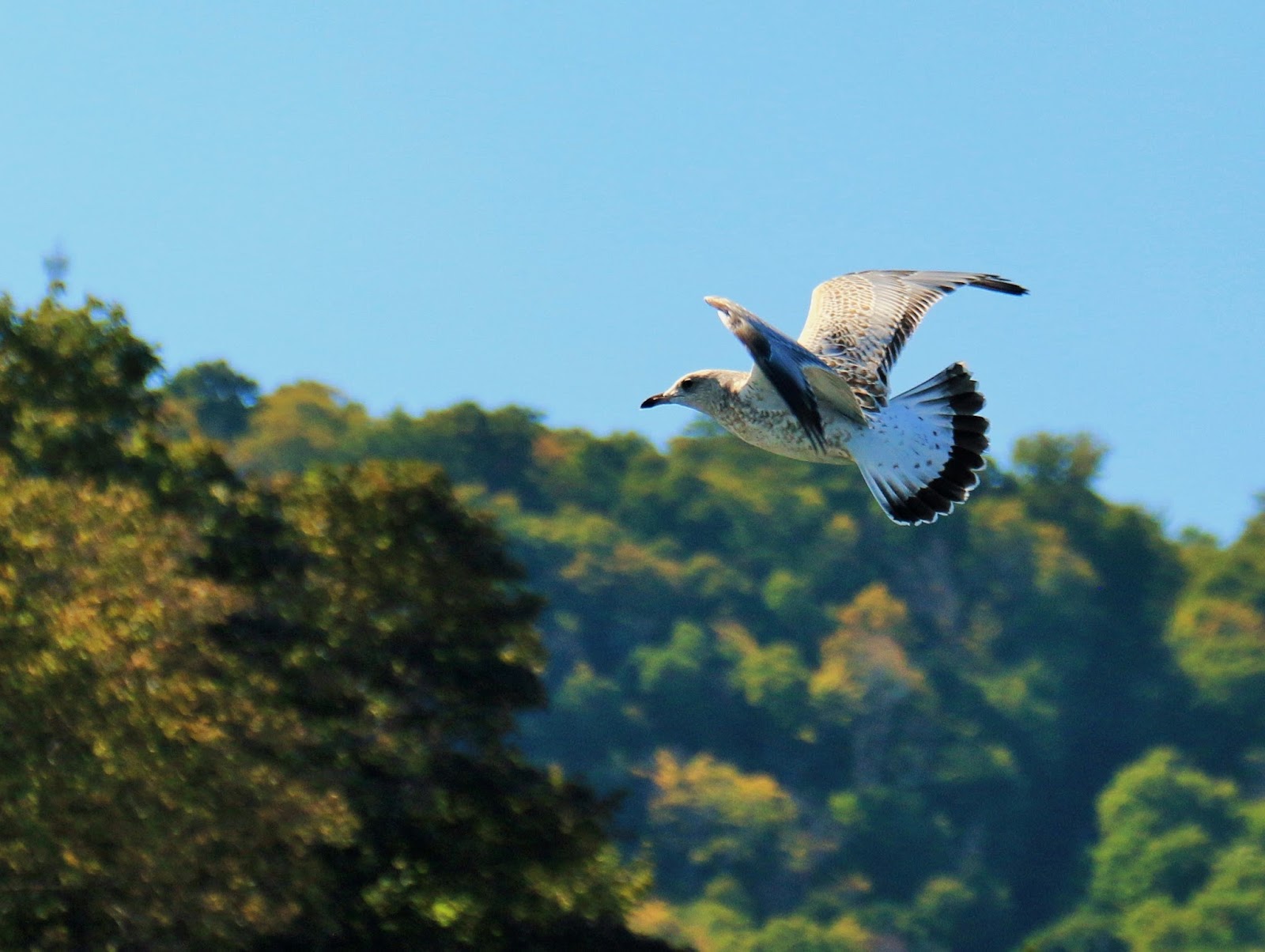
We also got into the cottage and changed our reservation to a single night.  Then we were off and back down to the marina to wait for our cruise.  So, what do you do while you’re sitting in the sun … waiting?  You look for something of interest to photograph.  Birds are what you see at a marina. 

I don't know what this little guy was but he sure was cute and liked to dive.

I call all of this type of bird a gull.

But it sure had some pretty tail feathers.
Then it was time to board and we were off, headed to the beauty of Pictured Rocks.  The Pictured Rocks Lakeshore is a 15-mile-long wall of sandstone running along the Lake Superior shoreline.  It has cliffs ranging from 50-200-feet above the lake, and numerous caves, nooks and crannies created by Mother Nature. 

The East Channel Lighthouse is located on the privately-owned Grand Island..
Pictured Rock cruises began in the 1920s, were suspended during World War II and started up again in 1946.

Miners Castle is the most famous formation of the Picture Rocks Lakeshore and is also accessible by vehicle.
Although I don't know that anyone ever jumped, this is called Lover's Leap.  The names given are quite descriptive, though.
Spray Falls was at the far end of our tour.  Almost all of the other little waterfalls that you would ordinarily see on the cruise were dried up this year.
Indian Rock is another of the more famous rocks along the lakeshore.
The rock colors are pretty spectacular.
There are all kinds of caves in the sandstone.  This is part of the Cave of Many Colors.  I think the two little caves on the left look like eyes checking us out as we went by.
The minerals seeping out of the sandstone cracks are what create the beautiful "pictures" on the rocks with colors that range from red-to-green and most everything in between.   What makes this one so interesting is the rock formation. 
The incredible color doesn't begin to show up in the photo as beautifully as when we saw it.
The boat cruise was well worth the time in order to see this beautiful place, and I’d take it again, although it would be hard to beat the day we had with blazing sunshine, warm temperatures and calm water.  And another plus?  They even have free kenneling for your pet while you’re on the cruise.

We headed back to the cottage for the night and waited for the lunar eclipse.  I spent a couple of hours outside playing with the camera and tripod trying to find the perfect spot to take photos from and to get a shot that I deemed worthy of posting.  I think I did it … and these are a few.


What a treat to see this eclipse on a clear night.  I finally went inside when the clouds came in and finally kept me from seeing the moon at all.


Monday, October 5, 2015

The lighthouse tour

After leaving Calumet, we headed on to see our first lighthouse.  Lake Superior is the site of numerous lighthouses and light stations, and we can’t even begin to see them all.  What I did not realize is that there are some that have been sold to private parties and some of the ones we saw are operating as bed and breakfasts.  They also offer tours of them, but we didn’t do that. 

The first one we visited was the Sand Hills Lighthouse Inn, about 25 miles from where we started out this morning (Friday, Sept. 25.  Yep, we’re still on the same day.)  The Sand Hills Lighthouse is the largest lighthouse built on the Great Lakes.  It was built in 1917 and housed three lightkeepers and their families.  It remained active until 1939 when the Coast Guard took it over and automated it.  It was also used as a training site during World War II, housing 200 men. 

This lighthouse isn't what I expect when I'm thinking of a lighthouse, but it was still very cool to see.
 
The current innkeepers purchased the lighthouse in 1961.  It was boarded up for 31 years and then in 1992 they began renovations, and welcomed their first guests in 1995. 

We drove a bit further and went to the Eagle Harbor Light Station, the most visited and photographed one in the Keweenaw.  This one is more in keeping with what I envision for a lighthouse, a round tower, rather than the square one we saw at Sand Hills. 
 
The Eagle Harbor Light Station is beautifully kept up and quite the showpiece of a lighthouse.
Roads were almost non-existent, and water was the means to bring settlers and supplies in, as well as to ship out copper and logs.  Lake Superior can have a nasty disposition and the ships needed navigational assistance.  In 1851 the first Eagle Harbor Lighthouse was established with a wooden tower and a sperm oil lamp.  It was built at a cost of $4,000 but was poorly constructed and quickly deteriorated so a second one was built of brick in 1871 at a cost of $14,000.  The tower is 44-feet high and painted white on one side so the freighters could see it and red on the other, making it quite colorful.  After being served by 21 keepers in its first 129 years, it became fully automated in 1980.
The grounds house a number of artifacts as well as a couple of museums.
In a typical season 50-100 “salties” (ocean-going ships that also come onto the lakes) pass the point, traversing the entire length of the St. Lawrence Seaway from the Atlantic Ocean, carrying a variety of cargoes between Duluth/Superior and the rest of the world.  Ships that are westbound are usually no more than five miles from the shore while ships that are eastbound are usually at least 12 miles offshore.  Typically about 35 million metric tons (lighter than a U.S. ton) passes this way with about 50-53 percent of it being iron ore, 30 percent of it being coal, grain using being between 8–10 percent and other cargo measuring 8–10 percent.  About 80 percent of the cargo is for domestic trade.

Eagle Harbor is open to the public and we climbed up the stairs to the bedrooms above that are set up as a museum with old beds and baby carriages. 
 
Going up the narrow staircase could be a hardship on those who are claustrophobic.

These rooms at the top looked so small.
While the Keweenaw Historical Society operates the history museum, the station is still operated  by the Coast Guard and they come twice a year to perform maintenance. 

 
Before we reached our next lighthouse we saw a sign ... the beginning of  U.S. 41.  If we followed it 1,990 miles we could get to Miami, Florida.  Maybe that's a ride to do sometime.
The Copper Harbor Lighthouse next on our list to see.  It was among the first beacons on Lake Superior.  It’s now automated and mounted on a steel tower, and the light can be seen as far away as 12-1/2 miles.

The original Copper Harbor Lighthouse was built in 1848 and replaced by the present structure in the 1860s.
So you can get a taste of what life in a lighthouse was like back then, the current Copper Harbor Lighthouse is set up as an 1847-era lighthouse and light keeper’s home, totally restored and furnished in a 150-year-old way to look as though the keeper still lives there.  It’s across the little bay and requires a boat ride to get to it.  There were no boats, and we didn’t see a posted schedule, so we continued down the road.

Honeycrisp apples are my current favorites.
Along the way we stopped at a roadside stand and I made a haul, Honeycrisp apples and pears.  The pears weren’t that good, but the apples were heaven.  We bought about five and I started to eat one.  After the first bite, I went back and got another six.  Yum, yum.  Yep, this photo shows I’ve already eaten two of them.

The colors still aren't quite there. 
While the colors still aren’t at their peak, they are a-changing, and I’m taking a photo here and there.  They’ll get there, but I’ll be long gone.


Thursday, October 1, 2015

Copper mining and old towns

Staying on the water has its advantages as we got to see a boat go under a bridge that was not a drawbridge, and then the bridge was lowered and vehicles once again started across. 

I love bridges.  We went across this one and it's grated.
On Friday, Sept. 25, we drove a few miles to Calumet, Michigan.  Calumet is a historic old copper mining town that is being revived and renovated.  It was originally known as Red Jacket until 1929 and was directly tied to the Calumet and Hecla Mining Company.  The copper mining eventually ceased but beautiful old buildings remain.  There are a number of museums and we walked around taking photos. 
This interesting fire alarm is on the side of the firefighter's museum.

The fog rolled in and out the entire time we were in Calumet, making for some eerie photos and the thoughts of ghosts from the past.
One of the buildings is the Copper Country Fire Fighter’s History museum, shown above.  It was originally a fire station, made of Lake Superior sandstone and built in 1898.  We wandered in.  The lower floor houses old fire trucks, both the horse-driven and mechanized types.  The upper floor has memorabilia but some parts of the old building were under construction.

Horse-drawn tanks came after the first modern firefighting equipment ... a hand-drawn tank from which water was pumped under pressure by means of an eight-man, long-handled pump.
 
It's come a long ways from the colonial days and bucket brigades that relayed pails of water to the fire and back to the well to be refilled.  Everything was so packed in we didn't try to get in close to any of the vehicles.
 
Come to find out a worker found us and told us the place wasn’t open and we shouldn’t be in there.  Whoops.  We took a few more photos and exited.
 
It was a pretty plain Jane existence.  You can see the fireman's pole between the beds that they used to get to the first floor where the vehicles were parked and ready to go.
Calumet had, at its peak, 34 churches.  Of those, 9 are still standing and being used for non-religious uses, 14 have been demolished and 11 are still active. 
 
The Slovenian immigrants who came to work in the mines established the wood frame St. Joseph Roman Catholic Church in 1890.  A fire destroyed the church in 1902 and they began construction the following year on this elegant church built of locally-quarried Jacobsville sandstone.  It was completed in 1908 at a cost of $100,000.  The stained glass windows came from Ford Brothers Glass Studio of Minneapolis.  In 1966, four parishes consolidated, making this building their church and changing the name to St. Paul the Apostle.
There are still a lot of bars.  I wonder if any of those ever closed.

Shute's Saloon (Marco Curto's Saloon) was one of 48 bars in Red Jacket in 1900.  By 1908 they numbered 78 strong.  While the main floor of Shute's has always been a working saloon, members of Local 413 of the Cigar Maker's Union held meetings on the second floor around 1900.  Shute's retains many original interior features, including a stained-glass canopy over the bar.

We spoke with a young lady outside of this building.  She and her husband have purchased it and are working on renovations.  Their dream is to restore it and reopen it as a market, in keeping with its history.
Another building that drew my attention was the former Michigan Hotel.  The hotel apparently served a very elite clientele, providing carriage service to bring its patrons from the railroad depot.  It has beautiful yellow, green and red trim, and even now is eye-catching.

The Michigan Hotel was designed by Charles W. Maass as a showplace for the Bosch Brewing Company.
Red Jacket (Calumet) was not without culture.  By 1898 the village had a surplus in its treasury and local leaders decided to expand the town hall by adding a 1,200-seat opera house.  The theater opened March 20, 1900, with numerous well-known performers making their way to its stage over the years, including John Phillip Sousa, Sarah Bernhardt, Jason Robards, Sr., and Douglas Fairbanks, Sr.
The Calumet Theater was one of the first municipal theaters in America.  It was the "greatest social event ever known in copperdom's metropolis," and even boasted an electrified copper chandelier.  John Philli
One of the more famous buildings is the Italian Hall that was home to the Societa Mutua Beneficenza Italiana, an organization that aided immigrants and others in need.  It was built in 1908 and housed a saloon and a tea company store on the first floor.  There was a main hall with a dining room, a bar room and a stage on the second floor.  It also hosted meetings of the Western Federation of Miners. 

This is the Italian Hall on December 25, 1913.
The hall was the site of one of Michigan’s worst tragedies during a copper miner’s strike in 1913-1914.  After five months of the strike, Italian Hall was the location for a party for the striking workers and their families, in an effort to help lift spirits and improve morale.  On Christmas Eve 1913, 73 people, most of which were children, died due to a false alarm of “Fire.”  They died trying to exit the building down a single staircase. 

The arch to the hall was of a variety of colored stones.  The arch was located at the left side of the hall.
 Meetings continued to be held there, but the building’s condition deteriorated and it was torn down in 1984; however, the archway from the main entrance was saved and in 1989 a park on the site was created and dedicated to those who died in 1913.
The arch is a beautiful piece of architecture, but a sad reminder of a tragedy that shouldn't have happened.
As we were headed out of town a large piece of equipment parked next to the road caught our eye.  It was an old snowplow.  The Calumet and Hecla Mining Company couldn’t afford to let winter derail its operation, even in a remote region that can receive up to 300 inches of snow a year.   So, they used a steam locomotive to push the Russell Snowplow through the snowdrifts to open the line.

I thought the color of the snowplow quite appropriate for all and Halloween.
While seeing the snowplow as we were leaving seemed to end our tour of Calumet, a tall tower across the street seemed unique enough to make a detour through a school yard.  The tower is attached to a building that wasn’t nearly as interesting.  Except, that the building was the old Superior Boiler House. 

The Superior Boiler House.
All of these remaining buildings and mine shafts have a rich history, and the ones here, including a railroad round house, a gear house, a dry house where miners changed soiled clothes for clean ones, and a warehouse, surround a school and its yard.  Supposedly by having the Calumet and Hecla Mining Company administrative building and other buildings here they could influence the curriculum and activities.

The Superior Boiler House used coal to produce the steam power for the buildings.  What had attracted me to the building is the beautiful stack made of brick that is not just a round stack, but has angles and is absolutely gorgeous with some greenery growing at its base. 

The tower was spectacular with its wonderful angles and greenery growing along side. 
So far, my short tour of Michigan has been a fun time, but it isn’t over.  Now we’re starting our shoreside visit of Lake Superior and our lighthouse tour. 

Sunday, September 27, 2015

Senior stuff

Except we weren’t staying.  We had places to go and things to do and see.  We got up on Wednesday, Sept. 22, and spent a leisurely morning having coffee and breakfast and then packing for a road trip, in a vehicle this time as I still wasn’t 100 percent.

We were headed north, to Ontonogan, Michigan, where we were going on an ATV tour for seniors.  We spent the day driving leisurely to our destination.  Although the colors hadn’t really begun to change around here, there were a few things to photograph.
I love seeing farm equipment coming down the road.
While I do enjoy farm equipment, my day was made when we spotted a couple of swans on a pond.
We ended up in a cottage near a lake just as it began to drizzle.  The forecast for the next day was not so good either so there was a second reason I was glad we’d taken the truck. 

We awoke on Thursday, Sept. 23, ready to go on our senior tour.  This is an ATV ride where they have ATVs and drivers to take you on some back trails to look at the fall colors.  We met at the designated place to meet the bus that would take us to the fairgrounds, where the ride would begin.  It was still drizzling a bit, but it wasn’t unbearable.

There was a long line of ATVs lined up.  I counted nearly 30 of them, all kinds, all colors, all sizes.  We ended up with Frank, who had a Cadillac of an ATV with a covered cab, doors, windows, a heater and a windshield wiper.  We got lucky as we weren’t wearing any raingear.  We’d not even thought to bring any.  But they took care of us.  We got lucky with our driver, too, because Frank was from around the area and could give us lots of information.
Our driver, Frank, at 72, was more senior that we are.
 
Some of the ATVs lined up and ready to roll.
We rode on, along a trail that stretched for about 20-some miles.  It started out over rocks left over from copper mining.  We rode over old railroad trestles, stopping here and there to stretch our legs, take a few photos and chat with others. 
We crossed several old trestles.
There wasn’t really the color changes yet and people figured the peak would be a couple of weeks later.  When I was down a few years ago, it was the same thing.  Oh well.  We had a great ride and saw some beautiful country from the trail side rather than the road side.
The colors were just starting to change.
We passed over a few little rivers.
We ended up at the Twin Lakes State Park where they had a lunch of pasties, cookies and beverages.  It was fun, and it was free.  When’s the last time you got a free lunch?  Of, course, you can't count the cost of airline tickets, hotels, food and gas to get there to go on the ride.  As we had come the furthest for the event, we were even interviewed by their local news station.
What's for lunch?  Pasties!!!
Just in case we needed it.
There were still pretty leaves, even if some were on the ground.  The one at the far right makes me think of a leopard.
Some of the colors are vibrant even in the rain.
Once we had finished lunch we were loaded back onto a bus and taken back to where our vehicles were parked.  From there we once again hit the road, ending up at a Ramada along the river in Hancock, Michigan.  It was still cloudy and not the best weather, but it’s been a great time and it’s always pleasant to stay at a place where you can see the water.