Monday, May 29, 2017

Escape from the Intense Heat

The next day, Friday, May 19, we headed to Bridgeport, California, and then we’ll go to Death Valley.  We’ll hang out there a bit and then try to get to Lee Vining again in better weather.  No more snow.  

Anyway, we stopped in Truckee, and found snow again, but it wasn’t snowing; it was just up in the hills.  I was sure glad of that. 
I always like a good mural on the side of a building.
We rode around a part of Lake Tahoe, and some of the colors reminded me of what we’d seen in the Polynesian Islands … clear waters with turquoise-green water. 
The water and the snow-capped mountains were beautiful and the snow was just where I wanted to see it.  Up high.
There's a pull-out where people launch boats and such and some of the big rocks seemed to have been dropped
willy-nilly, here and there. 
All-in-all, it was a beautiful day of riding, and we had a meal at the Bridgeport Inn in this small town that was awesome.  Who’d a thought? 

A walk finished our evening, and we were happy to retire to blogging, reading and sleeping.
More snow, far away.  Yay. 

Our walk-a-bout lead us to this, one of a couple of good-looking wagons.
The following morning (Saturday, May 20), we took off for Death Valley, and Beatty, Nevada, where we’d spend a few nights.  We wanted to wander around a little bit here and go up and visit the charcoal kilns. 

It wasn’t a long ride, and we didn’t rush as there’s always something to see along the road.  We arrived in Beatty by late afternoon, had a bite to eat and made our plan for the next day. 

Sunday, May 21, was another beautiful day, and we set off to visit the Wildrose Charcoal Kilns. 
Corkscrew Peak is just before we started to drop into the valley, and the  heat.

In the distance I could see where we'd be riding into the heat of the day, even though it was still early.  I was hoping we'd get through the desert floor and up the other side before it got into the hundred-degree mark.
The road leading up to the kilns has two miles of dirt at the end, and is more like a mule trail than anything, with some larger rocks, washboard and gravel, but nothing like what we’d gone through for a short visit to Mono Lake a few days before.  (More on that later.)
This is the good part of the road, at the end near the parking.
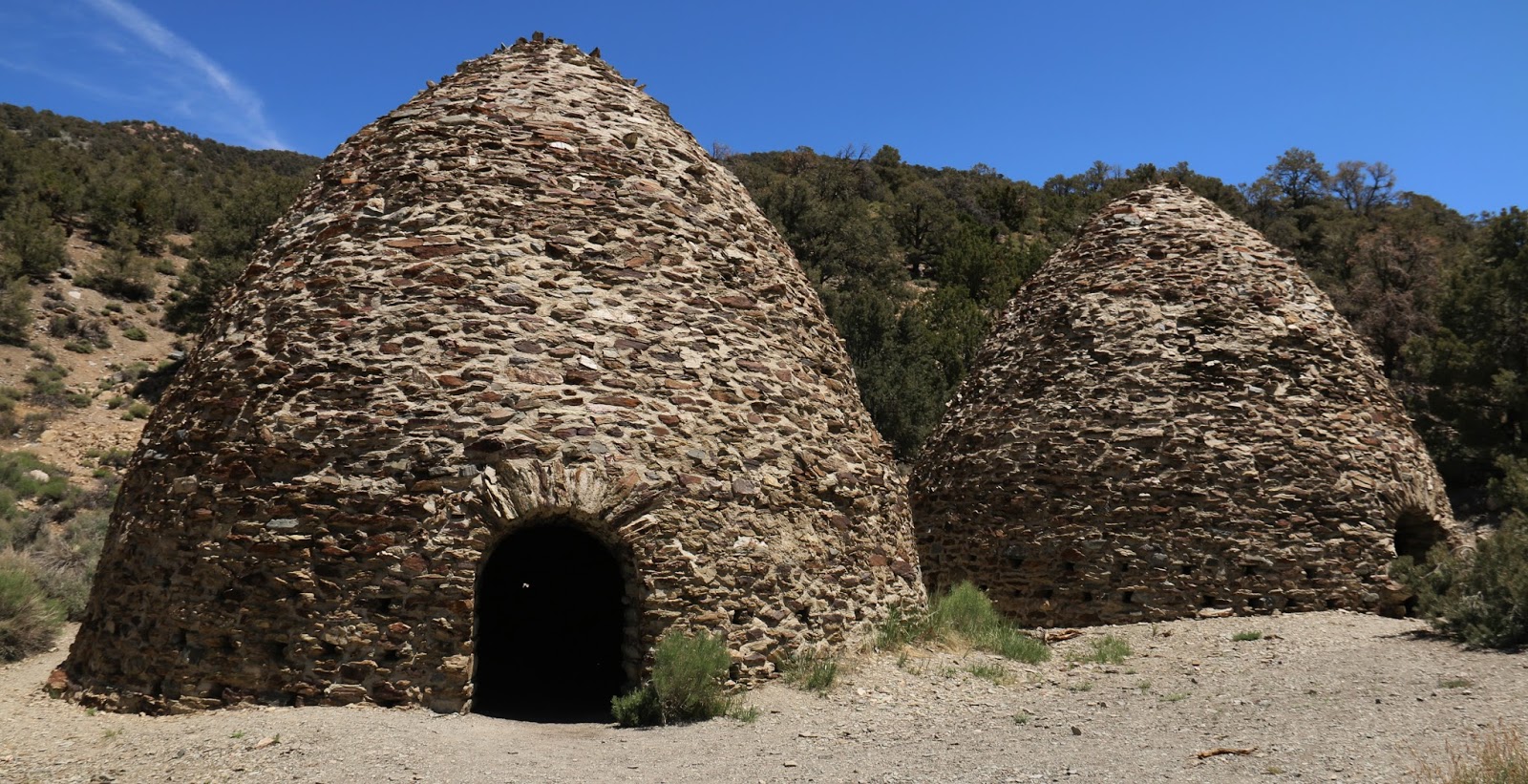
The kilns are a bit off the path, 37 miles from Stove Pipe Wells, at an elevation of about 6,800-feet, so there wasn’t a crowd of people there, which was nice.  There are ten beehive-shaped kilns, each about 25-feet-in-heighth and about 30-feet in circumference.  The kilns would hold four cords of pinyon pine logs and, after burning for a week, would produce 2,000 bushels of charcoal.  They are beautiful, real works-of-art, and are thought to be the best-known surviving example of this type of kiln in the United States. 

The kilns were restored by a Navajo restoration team in 1971.
 
We walked up the hill across the road from the kilns, looking for the perfect shot.

We pretty much had the whole place to ourselves.
They were engineered by the Swiss for George Hearst’s (yes, father of William Randolph Hearst, newspaperman), Modock Consolidated Mining Company and built by Chinese labor.  The charcoal produced by the kilns was to be used as fuel for two silver-lead smelters that Hearst had built 25 miles to the west.  They operated only for a short time, until the summer of 1878, when the mines closed down. 
Up on the hill we found these beautiful flowers.

The process of turning pinyon logs into charcoal took up to two weeks.  The burning which reduced the wood to charcoal took 6-to-8 days, and the cooling took another five days.
It was a beautiful spot with a postcard quality, and a LOT of bugs that ate us up as we later discovered as we scratched our way through the next few days.  They apparently loved the bug dope we used, thinking of it as a wonderful-tasting spice on their meals.

Saturday, May 27, 2017

I Can Drive a Locomotive

We got up and excitement was running high that Thursday, May 18.  We were off to the Western Pacific Railroad Museum to drive a big, yellow locomotive. 

A great logo for a great museum.
We were scheduled for 11:30 a.m., but we got there about 10, beside ourselves to get up into the cab of that engine.  We went inside and there were some of the workers there, volunteers mostly, that work on trains for their real jobs and then volunteer here during their off time.  We got all the waivers signed, and then our instructor and we headed out to the tracks.
Our locomotive, the Southern Pacific 2873 GP9, was built in 1956 and her operating weight is 247,600 pounds.  The Southern Pacific and Atchison Topeka and Santa Fe railroads attempted a merger in 1983, and while it was denied in 1986 and 1987, the railroads had been confident enough that the merger would happen and began repainting the locomotives into a new unified paint scheme, which our locomotive sports.  While the railroads began repainting back to the original paint schemes, some were sold with the merger paint scheme.  The SP 2873 was found in a scrap yard in Richmond, California, and came to this museum in 1992.
Driving a locomotive weighing thousands of pounds is pretty exciting stuff after riding an 8-900-pound motorcycle.

Our instructor, Charlie, getting us up-to-speed on running this big machine.

We patched out in horn-blowing.
I'm thinking now that the best view from a train is from inside the cab.

What's not to like about driving a locomotive ...
These are very dedicated people who work and volunteer and as we were quite curious about the problem that might have prevented us doing our drive, so we got the skinny on what turned out to be a derailment.

They were moving some cars and with all the rain they had had, the ground was soft, and when the cars went over the rails, the rails moved, with some of the wheels coming off the track and hitting the ground.  It was going to take at least a few weeks to get them all back on the tracks, and the locomotive rentals going again.

We were very fortunate that we were so persistent the previous day, so we got do to our train driving.  What a thrill … a big locomotive going down the track, tons of metal doing what you asked it to do.  But maybe the best part was blowing the horn … multiple times.  We were like kids in a candy store, but this was even better than candy.  Woo woo.  Here we come. 

After we finished our driving we spent a few hours wandering around, looking at all the different trains there … and it’s quite a collection.  We were fascinated with how many are here, and what great restoration has been done on some.
There were so many railcars and locomotives it was hard to see everything, but we made an attempt.
Always a personal favorite, a rotary snow blower.

This little engine was totally captivating.  She was built in 1939 by the Electro-Motive Corporation (a division of General Motors), and weighed in at 201,000 pounds with a a top speed of 45 mph.  The WP 501 was the Western Pacific's first diesel-electric locomotive.  It went west in 1939 to demonstrate the virtues of diesel power and was liked so much the WP purchased this one (with an original cost of $64,525) and two others, marking the beginning of the company's push to eliminate the steam locomotives.  Less than 14 years later the WP became the first large western railroad to be completely dieselized.  In 1965 she and one of her sisters were transferred to Sacramento Northern and renumbered.  She became a "hangar queen," a locomotive from which parts are stripped to keep others running, and many believed she would never run again.  In 1980 she and her sister were repaired, eventually came to the museum and were restored to their original
Western Pacific appearance.   

This little beauty was used as a Sacramento shop switcher.  And what I like about this museum is that so many of these machines are operational ... yep, she is.  Built in 1950, she was donated to the museum by the Sierra Pacific and is perhaps the only surviving Model TR6A. 
 
My favorite logo, with the Feather River Route.

Stef was up and down all over these locomotives.  The WP 805-A type was called a "covered wagon" and was purchased to power the Western Pacific's California Zephyr passenger train.  It hauled the train between Oakland, California, and Salt Lake City, Utah from 1950 to 1970.  It was then put into freight service. The Feather River Rail Society wanted this locomotive for its Western Pacific collection as it was the last WP California Zephyr locomotive in existence.  It was purchased in 1987 and cosmetically restored by 1995.  In 2000 money was raised for a complete mechanical restoration. 
Another snow mover, a wedge plow ... zebra stripes rock.  This plow was built in 1949, and looks like it needs a little work yet, but sure is a cool looking machine.
It was time for a short break so we went back into the diesel shop, that is a working railroad shop.  It was constructed in 1953 to repair and service the locomotives and cars for the Western Pacific Railroad.  When the museum folks arrives, every pane of glass was broken, the plumbing disconnected and half of the track broken or missing.  What a job to rebuild all of this and make it into a working shop with grease, locomotive parts and tools around.  It was fascinating.

One thing in the shop was this old railroad light ... that still works.
We wandered down the track until we found the derailed cars and wandered around them.  Some were leaning quite badly, so we decided if the ground gave way it might not be a good place for us to be.  It’s going to be quite a job to get them back up onto the tracks as we could see where the track had moved as the cars had gone over them.  You could just picture what had happened. 

The name apparently fits.  Some of the derailed cars in the background.

You can see where the track moved from and to.

On the ground.
We finally figured we'd seen everything and we headed back to the lodge for a bite to eat, and a dip in the pool and hot tub.  What a great way to end a day.

Wednesday, May 24, 2017

We Need Warmer Weather

When we got up Tuesday, May 16, we discovered there was ice on the bikes but it had warmed up to 34 degrees.  We figured we’d not be leaving too soon, but we did have a plan.  We were getting out of these mountains, hopefully ahead of the rain, and going somewhere that had a better climate.  Our plan was to go to Virginia City, Nevada. 
It's so much nicer to have the snow in the distance.
It was cold riding and we were watchful for ice.  We were lucky.  All we saw were some wet spots that we avoided.  I’d dug my electric jacket liner out and found that it still worked.  I don’t have electric gloves, but at least had the warm ones that I’d worn yesterday, although they’re not as warm as I’d have liked.  I also discovered my rain pants had melted together, or at least it seems that way which was why I couldn’t wear them yesterday.  But the jacket helped. 

We went through some more high passes, 7,626 feet for one of them, but there wasn’t any rain.  I was certainly grateful as we came down to Hawthorne, and motored along a beautiful, winding road.  It warmed up some, and there was a bit of sun.  It still wasn’t warm enough to take off any of our gear.
We rode through some farm roads that had some major flooding.
I thought this was interesting.  I'm thinking they cover up the plants or seedlings to help them grow or help protect them from cold weather.  And I can tell you, it's not been warm, so I'm figuring the little plants need all the help they can get.
There don’t seem to be many animals either.  We’ve only seen a few hawks and a Jack rabbit that crossed the road.  Pretty slim pickings.

We made it and got checked in to our hotel.  It was blowing like crazy but we wandered downtown to get a bite to eat and do some meandering around.  There were some cool things we found along the way, surprisingly cool, in fact. 

Who would have thought.  An old car with a tree in it ... with a chicken hanging from it.  Ya gotta love
 anything with a chicken.

And a tardis.  I didn't even know what one of these was until last October, and now I've found one in Virginia City.  I did not step into it as I did not wish to be transported somewhere else ... although somewhere with a little warmer weather would have been mighty nice.
We also found a store that had a dog greeter, a black lab named Puma Brown.  She wears a bandana (pink) and has her own Facebook page.   

Puma Brown, store meeter and greeter.
I do love a little tourist town, though.  Especially when there are hardly any tourists.
I have to say that staying at about 4,000-foot elevation is way better than being at 8,000 feet with snow, even if it was cold and we had to wear jackets and hats when we walked to dinner.

St. Mary's in the Mountains was built in 1868, burned in 1875 and rebuilt in 1878. 
 
It's a beautiful setting up here.

The Fourth Ward School was built in 1875.  The cut stone foundation is anchored in solid granite.  There are 14 classrooms and two study halls.  It was built to accommodate 1,025 students, from grammar to high school.
 It's last class graduated in 1936.
This donkey engine/steam tractor is from old Virginia City.

The little mountain bluebird is quite colorful.
We’ve done Virginia City and were now going to Portola, California, where we’ve made plans to drive a locomotive at the Western Pacific Railroad Museum. 

We hit the road on Wednesday, May 17, and arrived in Portola.  We’d thought our hotel was in town, but there really isn’t much in town, or even much of a town.  We walked around a bit checking it out.

The town is set in a very nice place, a stream and hillsides. 
And there are a lot of my personal favorites ... pine cones.
The place we were staying was about three miles out on a very nice winding road … a fancy resort with a golf course, pool, hot tub, spa, restaurant with linen napkins and a bar with ginger beer.  Wow. 

It's a pretty upscale place, but there weren't many people here yet.
The Nakoma Lodge.  It’s very nice, with fountains and a fancy golf course that we promptly tested.  There are plans for gated subdivisions, some of which are already started, and they’re even building a new activities building. 

Testing out the golf course, or maybe the practice putting green.  No hole-in-one here.
The rates were very reasonable; maybe it’s not quite the season yet.  We were pleased to stay in such a nice place.  And happy to park a couple of motorcycles next to a Jaguar to step up the neighborhood.


Then we got the bad news.  A phone call came in from the WPRM saying we couldn’t drive the locomotive tomorrow.  Well, we’ll just go on down there and find out what’s going on.


So, off we went.  The young lady at the WPRM was only able to say no one could drive locomotives until probably June, but there was no real explanation.  That didn’t set too well, so we set off to find someone, anyone.

As we wandered around there was an engine coming in and a guy got off and kind of came near us.  We chatted him up.  And we told him we’d come all the way from Alaska to drive a locomotive.  Well, the problem was that a train had derailed so the track they use for the thing like we wanted to do wasn’t open.  Okay, could we just drive it a little way?  We charmed our way into driving the locomotive the following day, maybe not as far as we would have, but we’d be on that thing for an hour, running it and blowing the horn to let everyone know we were there. 

Tuesday, May 23, 2017

Yes, It's Riding Time Again

Barstow was on the horizon, Sunday, May 14.  It was 440 miles away, and I was meeting Stef there.  I was having a nice ride although there was an issue with Highway 93 in Wickenburg.  It ends where I didn’t want it to end.  I finally got around heading north and the way I was supposed to go.  My GPS said to go south.  Can’t.  It ends.  Oh well.  A short detour.

I’d stopped for gas and as this couple drove by in their car the guy leaned out the window and said, “Have an extra special good day.”  How nice.  And I did.  It was great riding.  T-shirt, vest, no helmet until California.

The California border has an inspection station.  I pulled up and stopped.  The guy wanted me to pull up a bit further.  He asked if I’d like some cool air?  Sure.  There was a big fan there and he turned it on.  Wow.  It felt good.  And then I was on my way again.

Barstow is our usual meeting place, a Rodeaway Inn where they remember us and treat us very nicely.  Stef arrived about 4 p.m.  I arrived about 5:30 or so.  It was good to meet up again and be doing a motorcycle road trip.

The next day, Monday, May 15, we decided to head to Lee Vining, California.  There is a lake there with some cool things and we figured we’d maybe spend a day or two.  That wasn’t to happen although we sure didn’t know it at the time.

We rode merrily on our way, stopping to take a photo here and there.  One of the places we stopped was Pearsonville, California, the Hub Cap Capital of the World.  We found a few things of interest.  One was the Uniroyal Gal, who is also listed in Roadside America.  She’s a giant woman made of fiberglass with a blond flip hairdo.  What we didn’t know until later when we looked her up was that there’s a flower-adorned grave behind her next to a playground, of the Muffler Queen’s husband, whoever that is. 
The Uniroyal Gal, known locally as the Hubcap Lady, after a former resident, Lucy Pearson, who was rumored to have a hubcap collection in excess of 80,000.
We even found a load of garlic buds.  We could smell them before we got to them and knew what they were.
We could see snow-capped mountains around us when we stopped for gas.  It was beautiful.
We continued on our way, and the riding began to get bad.  We began running into a little shower here and there as we were riding through some high mountain passes.  By the time we reached Deadman Pass, at 8,036 feet, the showers had turned into a grand snowstorm.  Oh crap.  This wasn’t good. 

It just kept coming down, sometimes at a near whiteout … I couldn’t see and my windshield was covered.  I kept swiping at it with my glove.  I was cold, and apprehensive as I didn’t know how long this would go on or if it would be worse than what it already was.  Plus, I wasn’t dressed for this kind of weather.  I had planned on it being nice and warm.  I had put on more clothes at one of our stops, but they weren't enough.  Something white blew by me.  It turned out to be a sheet of ice sliding off the fairing.   We got through it and I was grateful that it hadn’t turned from Deadman to Deadwoman Pass.

By the time we stopped to take photos, this was all that was left.  The snow had slid down the windshield, and what had been on the fairing was mostly gone, too.
 
There was still a bit around the headlight. Ugh!!!
We got to our hotel and I was hypothermic, my teeth chattering and my body shaking.  A hot shower, the heat turned up to 77 degrees and hot water to drink helped.  Then I got into bed with my jammies, a fleece top and socks.  It made it all better.