Thursday, July 5, 2012


Back in the saddle again

Red, white and blue shirt, bandana and head covering in honor of Independence Day.
July 4 and I was on the road. It felt good to hit the highway, knowing I'm doing some miles again, serious miles, although not SERIOUS miles. I ran about 350-400. The sun on my face and running that yellow line down back roads makes me feel alive, alive, alive!

Yep I'm alive, I'm 65 and I'm going to arrive … somewhere. But I knew where this time, Elk City, Oklahoma. I don't always know where until I get there. That's the joy of a road trip. You don't have to set a time or place to be somewhere. You just know, or get so tired you have to stop. I love riding til that time or town shows up.

I followed Highway 160 out of Trinidad, and passed a ranch entrance flying our beautiful red, white and blue. I should have stopped to take a photo but I wanted to ride, to get the feel of the road under me again and to become one with Madame Harlow. When I go a few days without getting some miles on her tires our souls become a little bit separated.

It didn't take long to become one as we rolled through pasture land and valleys, between majestic mesas that rose from the ground. It's pretty green around here and I don't think that's usual. I saw cows and horses, the normal things, and a hawk or some type of eagle on an electric pole.

I'm not a farm or ranch girl but love cows, and windmills and what's associated with them.  And they make for great photos.  It really was beautiful country.  Up until the feed lots in Texas.  Peeeeyew!!! 
Riding that line is what it's about for me, and I think plenty of thoughts as I ride. I think of my friends, new and old, and the kindness, generosity and hospitality that has been shown to me over the past week or so. It makes a person feel good and rich to have such wonderful friends.

The speed limit was 65 but there was nothing out there, no cars, no cops. Madame Harlow and I were feeling the road. It felt so good, I bumped it up to about 80. With a road that is mostly straight, it was an easy ride and I needed to cover some miles.

Two birds considered hari kari and I had to duck. Now why did I do that? If they're going to hit me, it will happen. But Lady Luck or Mother Nature were on their side and they glided up and over my windshield, leaving no trace of of feathers or anything else on either Harlow or me. And on we rode.

This may have still been in Colorado, but I'm not sure.  There are ranch owners who have determined they will not sell their land to the Army.  The Army wants to buy up land that is way out from most anything and make a test site out of it.  The ranchers say ABSOLUTELY NOT!!!  I've seen a number of these signs.
With the heat rising, I put on my hydration vest, and continued to drink lots of water. It got hotter so I began stopping every 50 miles or so to re-hydrate the vest. Usually it's gas and go but today I decided it was better to take the time to cool off periodically instead of trying to bull my way through like I usually do. I sometimes get too focused on the mission (imagine that) and not on what I need to do to keep myself in good enough shape to complete it. Today was the exception.

Riding along with my feet on the highway pegs made me feel a bit like a frog. The pegs are high on the engine guard to keep my legs away from the engine heat. But since they are high and my knees are up somewhere around the gas tank, I just had this “I think I am a toad,” feeling. But riding along with the wind blowing my pantlegs blow up, and my little Alaskan white legs showing. I was glad I was wearing red and white socks and blue jeans. I was making a patriotic statement. But I did not look cool, and how uncool is that for a biker?

It was back roads nearly all the way, 160 to 287/385 to152 to 83 to I-40 for about 35 miles. I arrived at my Comfort Inn. I had found it and made a reservation using the Internet to tell me about the place. Isn't the Internet a wonderful thing? It sure is helpful, and it lets me tell my story.

This has to be how I looked today with my pant legs up above the top of my boots.  Maybe it's "look cool or stay home."  NOT!!  I was riding and that was all that mattered.


Wednesday, July 4, 2012

La Turista en el Campo

July 3, a day of laundry, repacking, freezing bottles of water and getting ready to hit the road. It's always fun to get ready, but hectic. Usually I go through everything on my bikes prior to taking them out, but I did not do that this time, so don't remember what I do or don't have. But hey, this is America. I can buy anything I need.

That is part of the joy of riding in the Lower 48. In addition to sunshine most every day, and roads that I've never travelled. So why do I live in Alaska where I can go only north or south? I guess because it's a part of who I am, too. Born and raised, needing the mountains and the water, ugly though some of it is. It's in my blood and my soul.

However, that said, I sure do love riding down here, the wind in my hair without a hat, jeans and no chaps, a T-shirt without long johns. Riding free, unharnessed by anything tight or too much. I do not feel like the Pillsbury Doughgirl riding down here. However, like the Girl Scouts I am prepared … chaps, electric gear, long johns, rain suit, just in case.

So today we went up to the coke ovens in the direction of Monument Lake where we were a day ago. It does not mean Coca Cola or the cocaine drug. Coke is a form of charcoal. They put wood in the ovens, and burn it without flames to make charcoal. The charcoal was then used to smelt minerals.


I really wish I could have gotten over onto the top of the ovens, but it was not to be.
The ovens are located 7 miles west of Trinidad in Cokedale. Cokedale was built in 1906-07 and cost $1 million. It was named for the nearby coke ovens and was a mining / coke burning town.

The coke ovens are interesting to look at, two long lines of concrete with dirt in between them, and little cut outs. About 190 of the original 350 ovens remain, with the 350 ovens being the largest number of ovens in the county at the time. I found the long line of ovens quite interesting, but was unable to get to them to explore as they were behind fences.

Later in the day we picked up Verlie's Aunt Lucille and Uncle Charles and off we went for a ride about the country. Originally we were looking for some coke ovens around Gray Creek and Engleville that we heard were in excellent condition, but we never found them.

However, we found some interesting things to photograph, like a little house with a cross on the top and a cross as part of one of the windows.


A beautiful little stone building.  I loved the cross on the top.

This little monument was off to the side of the little stone building.  There are fascinating things to see even out in the country where you might not ordinarily be.

I like to cook but can't imagine using an oven like this.  I'm told, though, that this was used to melt metal.
There was also an outdoor oven which I thought was a neat thing that I'd rather never have to use. Mostly we wandered around in the Trinchera area where Verlie's mom was born and raised. There's not much there now, but there were a few old buildings that were unique to see. Trinchera was founded in 1888, and named for the pass or gap through a nearby mesa. It's Spanish for trenches.

The old church at Trinchera is still standing.

We're driving along, in the middle of nowhere, and there's a microwave oven on a post.  Have you ever seen such a strange mailbox?  I guess that's the epitomy of recycling.  Give that guy a blue star.

As we rode about the country dirt roads, we saw antelope, turkeys and even a bear which sat on his haunches to watch us. He seemed to be questioning what we were doing in his turf. I was quite content to be in the car at the time.

This bear did not seem to be very concerned about us ... my favorite part of seeing things, the animals.
Yeah, I should have cropped this one of the antelope.  Next time.
We also drove through what used to be Watervale, but the buildings were all torn down after the community was abandoned in the early 1920s.

From there the road continued to Branson where we found an outhouse to use. We were long past caring if it was a nice place or not. But it was clean and was even equipped with toilet paper. The scavenging in the car to find paper of some sort to use was no longer an issue. There was even a funny little jail there so we all took a chance at getting behind the bars, hoping to not be the one that got locked in by accident.


Let me out,  Let me out.  I've never been in jail, and don't really want to find out what it's all about.
All you wanted to know about the Branson, Colorado jail.

At least there were beautiful flowers at the jail.
One of the things we did a little offroading to get to was to visit cemetaries. Again, I find them unique and fascinating. Each has its own way of honoring those who have passed on. Some of the ones we visited today were old, and they had a different type of cross than ones I've seen before. A few had photos, one had no “death” date because the person has not yet passed on, and others were broken down, neglected and forgotten.
So many old graves and markers no longer marking anything.  They're sad to see.
This marker had a photo of a handsome man, a beloved dad and grandpa.
Another marker with a photo.
This gentleman is still alive.  Somewhere.
Neglected, forgotten, broken.  Yet the flowers don't seem to be so old.
There was one grave, Tito Sandoval, who was Verlie's Mom's uncle. He died at the age of 34 after a fight with someone else. The two took the fight outside where Tito figured he'd make short work of it since he was an excellent boxer. That was not to be as the other guy pulled a gun from his boot and killed him.

Uncle Tito, dead before his time.
The stories that come from the grave are more interesting than anything someone could make up. I only wish more of them could speak to us and pass on their stories as not many are still here to speak for them. What a day.

Adios, my amigos y amigas.

And a HAPPY FOURTH OF JULY.  HAPPY BIRTHDAY AMERICA.  WE LOVE YOU.

Tuesday, July 3, 2012


La Turista in Trinidad


Verlie and me under the Trinidad sign.
Staying at someone's home allows for doing La Turista things that you might not ordinarily do. If I was just traveling I'd be blowing through this berg, adding up the miles, and moving on down the road, running mile after mile after mile, stopping only to gas and go.

Overlooking Trinidad.
Trinidad is a bustling, but laid back little town, located at about a 6,500 foot elevation, with lots of beautiful old buildings and a rich history. My friends Joe and Verlie, and her Mom, have shown me places I'd have never seen.

On Saturday, June 30, we drove up a dirt road to view the St. Aloysius church (seen the day before from the highway) that is now mostly nothing more than the front wall. The bricks, and other building materials used have mostly disintegrated with time, but it's still beautiful and we're hoping to get my bike close enough to get an awesome photo.

I walked all around the church,  and really needed a photo because of the beautiful architecture.  There are red bricks covered by a gray material, covered by the outside red clay-looking material.  It mostly crumbled in my hands when I picked up a piece of it.  But while I might explore, I'm always on the lookout for snakes.  I'm scared of snakes; hate 'em. 
The church, located in Morley about 12 miles south of Trinidad, is one of the most photographed sights in Las Animas County and there are currently plans being made to stabilize and restore the structure. It was erected in 1917 for $2,300 and was the second Catholic church to be established in a CF&I (Colorado, Fuel & Iron Company) camp.

I'm not exactly a religious person, but churches are some of the most beautiful buildings in the world, in my opinion.  I was particularly drawn to this one and believe that maybe I had been born in another time and era.
There are many weed-covered foundations near the church site including a fan house. The fans in the fan house draw fresh air into the mine shaft and remove contaminated air, which was quite important since this was a coal-mining community.

This is what looked like an ice house, with a staircase leading down into it.  Once again we wandered around, but I stepped carefully, looking down and around before setting my foot anywhere.  Because even though I'm wearing motorcycle boots with a built up sole I'm afraid of snakes.  But I was braving it out as my inner self was called to explore where I had not been before, overcoming my worrying about snakes.
The old ruins are fascinating but the heat melts me.  An old white girl from Alaska is not used to the heat and my white skin burns in no time in the near-100 degree temperature.
The old Morley Station was later named Gallinas, Spanish for hens. This particular area had history that spans years, and there are remains where you can see there were many people who lived here, about 900 at its peak in Morley, with over 1,000 tons of coking coal produced on a daily basis.

My beautiful friend, Verlie, in one of the ruins that we thought might have been a hotel.
Another large ruin of what we wondered if it might be a hotel.  Apparently there was at least one, maybe more, hotels.  Ruins are fascinating, but there's never enough time. 
This one looked like an orchard was growing in it.
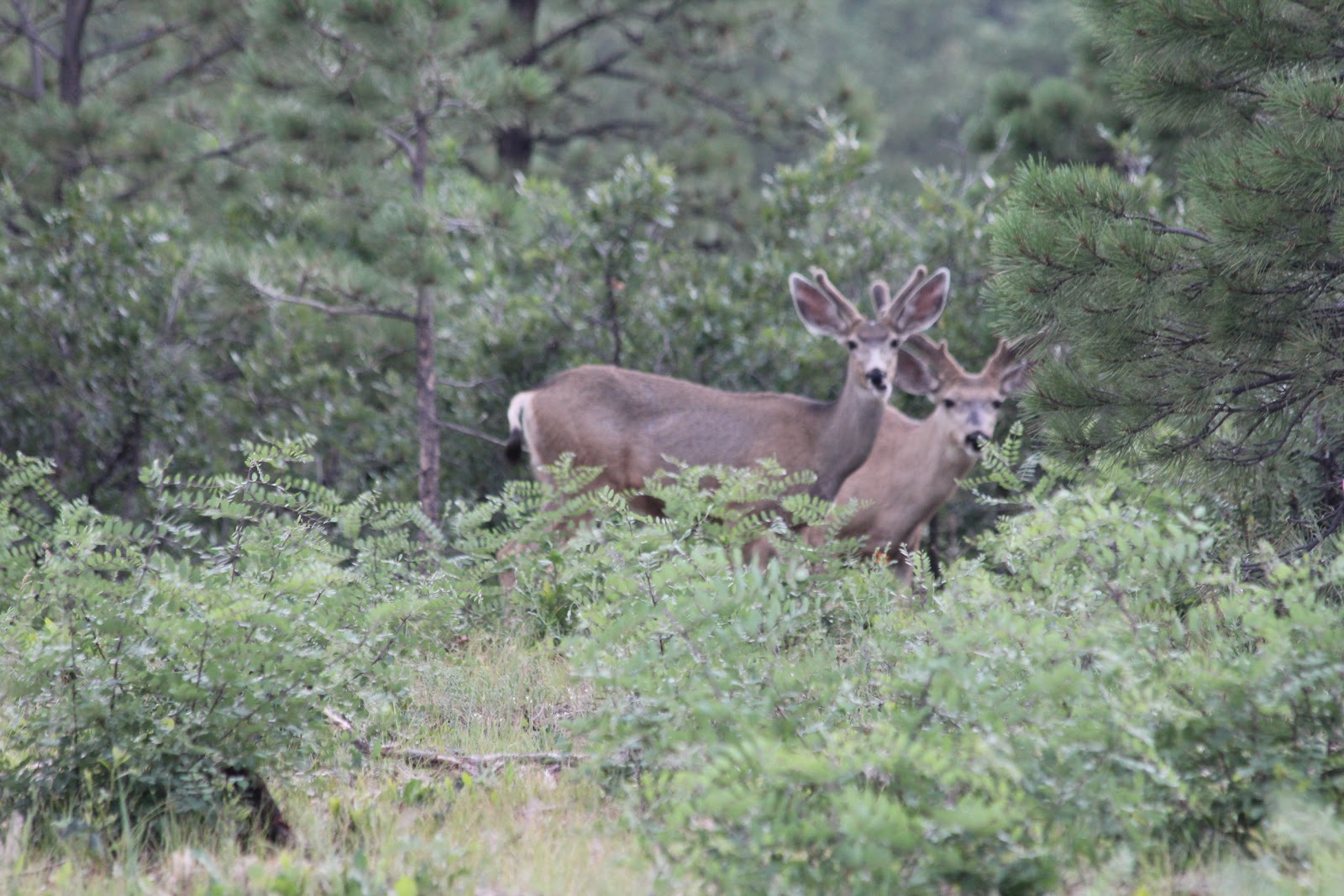
We followed the road probably 25 miles or so, and saw some spectacular homes up in the mountains and more deer. Of course, I had to try to sneak up on them so I could get the “perfect” photo. It was a group of three males, which Hobbs says is a “bachelor” group, young males bonding together until they establish their own area. It was a great time.

Two of the boys at attention. 
Look at those ears.  They're longer than his antlers.
This one's for you, Hobbs.
I also took more photos of Fishers Peak. We were on the other side of it, so then the “car” that it looks like was reversed and going in the other direction.

Doesn't it look like a car, with the hood out front and the cab?  Fisher's Peak.
Above the town, there is a big sign for Trinidad, which lights up at night, and we drove up up Simpson's Rest to the sign. Simpson's Rest guards Trinidad, that is referred to as the gateway to the Mountain Route of the Santa Fe Trail.   On Father's Day only the "DAD" is lit.

The sign with a flag.  Love the flag.  Can hardly wait to wear my stars and stripes shirt July 4 as I head on over to Oklahoma to meet my friend Ruth from Kansas.
George S. Simpson, who is buried at the top of the rest, was a pioneer. He was a famous scout, trader and explorer, born in 1818 in St. Louis, Missouri. He came to the Trinidad area in 1848 and served as the region's first territorial county clerk.


Simpson's monument is quite beautiful but covered with graffiti.  What's the matter with people that they  have to vandalize things?
The reason Simpson is buried on the rest is a story about a Ute Indian attack. He fled up a nearby butte and hid inside one of the crevices. After three or so days the Indians left, Simpson emerged thankful to the rock for hiding him and had a desire to be buried there. In September of 1885 the Rest became his final resting place. It's a very cool story, and just one of many of the local lore.

Verlie and Joe at the top of the hill by the sign and memorial.
We then visited the cemetary where Verlie's dad and brother are buried. It's a beautiful cemetary, well-kept and peaceful.

Verlie's Dad and brother are buried here.
There had been little American flags placed reverently beside the graves of those who have served and died, a reminder to all of us that “Freedom is not Free,” and we should honor those who have died for our country, and those who have served and are serving. I'm quite emphatic about this. If, as Merle Haggard sings, “If you don't love it, leave it,” I think that says it all. I love my country and my flag. God bless America!!!

There were a lot of little flags placed at gravesites, but this one struck me as special.  I think it was the cavalry this person was a part of and the fact this one was quite old.  And horses, both four-legged and iron are also a large part of my being and who I am today.

And always sad are the graves of and memorials to children.
Then all sadness flew from my mind as it was on to a wonderful dinner at Blackjack's Saloon. The salad bar was excellent and I had sweet but spicy riblets. YUM, YUM!! Yep, it all comes back to food.  And all else was forgotten for now.

Another beautiful day dawned on Sunday, July 1. Woo hoo. Nothing but sunshine. Verlie's Mom wanted to go to church, so as all were going I said I would, too. It certainly can't hurt me, and it was pleasant with lots of singing. I've always liked church music, so I was happy with it.

Then it was lunch and I told them I had to ride. I'd been off the bike for a couple of days and was suffering massive withdrawal symptoms.

I followed the car and we took a very nice two-lane road with some twists and turns out to Stonewall and Monument Lake.

Yes, I know.  Another deer.  I love animals and taking photos of them.  I can say no more about that.
Stonewall is a little bend in the road amongst numerous ranches with large pastures and little streams. The hook here is a great wall that is narrow but visible through the entire area and beyond. The little village is located around a large gap in the Dakota Wall at the foot of the Sangre de Cristo Mountains. The wall was originally known as Stoner's Wall, named after James Stoner the first postmaster in Stonewall, and for whom the town was named. But I've been unable to find information about why or when Stoner's Wall changed to the Dakota Wall. Oh well, enough research and on to other things.

This is the wall from one side as we approached.
The town of Stonewall is at an elevation of 8,000 feet (no wonder I cannot catch my breath) and is in a territory claimed by the Trinchera elk herd. I saw no elk, but did see a deer, a female muley. They're all so beautiful. As told, as of 2006, the humans living here were outnumbered about 100-1 by the elk. Again, can't be proved by me.

This is the wall edge where the road passes through.  The wall has been cut out for the road.
The Dakota Wall outcroppings were beautiful and of course, I had to have a photo of the bike with it. We decided to use a little ranch road and of course, gravel is not my friend. No drops, but it took a bit of time for me to get in, turned around and in position. The photo Joe took was well worth the angst of getting into position even with the heat, and the lack of air. I need an oxygen tank, I think.

Gravel and I don't get along, but I love this photo Joe took.  The gravel road leads into a ranch, and of course, there was a "no trespassing" sign.  Those are ignored when it comes to getting a photo.  As are speed limit signs and exceptionally pink stop lights,.
From there we headed up the road to Monument Lake. It's a beautiful spot where Verlie's Dad used to take her fishing as a girl. There was a large piece of rock in the middle of the lake, but now it's just a tiny piece sticking up. People were there fishing, and catching what looked like a nice trout. The chipmunks were out and looking for food.

Verlie, her mom and me at the lake.
There were lots of young ones, and they kept trying to get into the fisherman's bag. Joe tossed some popcorn out but they turned up their little chipmunk noses at it. Later when we weren't paying as much attention to them they came back to get it. Joe saw one of the little ones bury a piece of popcorn so guess the little guy is planning for the future.
What ya go for us, dude?
Even butterflies like motorcycles.  This one matches my bike, black and white.  It was eating bugs off the bike.  It couldn't do enough eating to clean this bike.
Joe, Verlie and her Mom.
Then I needed a bike wash. I'd not washed Harlow since the Harley shop and she had been in great need of a wash after the monsoon. Then back to the barn for her.


Harlow getting a wash and dry.  I really like the blow dryers some carwash places have.
Off we went to eat at Rino's a nice Italian restaurant in a former church. There are singing waiters, and excellent food. Yep, it all comes back to food.

 July 2 was another beautiful day and it was time to go up and take the photo at St. Aloysius ruins. Verlie, her Mom and I headed up. We got over the bridge, and then it was dirt and gravel for the 2-3 miles it took to get there. I took it slow, but there were some very sharp corners, and I took it slow and easy. I hate gravel as I've been down in it more than once, and scared out of my mind while riding on it many other times. But hey, a biker needs her photo with certain things, and I'd decided this was one of them.

I made it to the wide spot in the road, and with Verlie as my spotter, we got the bike in the exact position to catch it and the church. She took the photo I asked her to, many of course, because film is cheap and I like lots of photos so as to get the “perfect” one. I think she did it.

Is there ever a bad photo if there's a bike in it?  The sun was in a good spot for us, and we got the bike turned around, no incidents.  YAY!!
Buenos noches.